The Snowball Effect
Plastic pellets
Hong Kong has a plastic pollution problem. It has one of the highest waste-production rates per person. Up until now, the solution has been to bury it in landfills and to cosmetically clean up popular beaches when plastic debris washes ashore.
On the night of 23 July 2012, when Severe Typhoon Vicente passed through south China, Hong Kong’s plastic problem suddenly became international headline news. Six containers loaded with 150 tonnes of polypropylene pellets (the raw material used in thousands of plastic products) fell off a vessel into rough seas east off the Ninepin Islands.
As the containers smashed onto islands and ripped open, sacks filled with the polypropylene floated free and burst, releasing billions of pellets less than one centimetre in size, which washed up onto Hong Kong’s beaches. Piles resembling snowdrifts began forming on land.
The massive scale of the spill became apparent two days post Vicente. Plastic “snow” was reported by volunteers from DB Green and Sea Shepherd on Discovery Bay’s North Beach, while full bags of pellets washed up on Shek O beach, some 30 kilometres to the southeast. Soon after, pellets and bags were seen on dozens of other beaches on the islands of Peng Chau, Lamma, Cheung Chau and Lantau. In response, one of the largest collective environmental actions in Hong Kong’s history began to take shape. (See timeline for key developments on the spill).
The urgency to start the clean-up operation was compounded by the fact that pellets can collect high concentrations of hydrophobic toxins and pollutants like PCBs, pesticides and herbicides on their surfaces. The longer their time in the water, the more toxins they can potentially adsorb. The pellets also resemble food such as fish eggs for many bird and marine species, which potentially raised the spectre of deaths at Hong Kong’s fish farms and of toxins getting into the food chain and harming threatened species across the territory, including the beloved Chinese white dolphin and Green turtle.
WWF-Hong Kong took swift action. Our marine biologists brought their considerable expertise to the clean-up operation. Dr Andy Cornish, Director of Conservation, visited Tung O Wan on Lamma Island on 5 August to assess the extent of the spill and to help with the clean-up.
A strong early response from green groups and volunteers across Hong Kong prompted WWF to concentrate resources on more remote parts of Hong Kong waters. Samantha Lee, WWF-Hong Kong’s Senior Conservation Officer, says, “When it became obvious that this was not an isolated spill and that these pellets were everywhere in southern waters, we had to take action.”
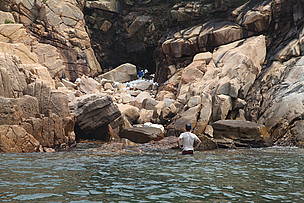
WWF’s first mission was to the remote Soko Islands, a habitat for both the Chinese white dolphin and Finless porpoise, and where one of the containers was salvaged. A large amount of debris was found on the beach: plastic pellets, plus a vast tide of other garbage, mostly used polystyrene boxes. In one cave the boxes were piled metres high (see photo on p.4).
Led by Lee, WWF’s operation gathered focus and force, moving to southeast Hong Kong — specifically Waglan Island, Beaufort Island and the Po Toi Islands (see map). “We decided to adopt these islands because of their inaccessibility and their high ecological value,” she says. “Beaufort Island was at the centre of our efforts as a container smashed open there, releasing millions of pellets into a small cove.” WWF requested volunteers to assist in clean-up missions to these islands.
Across Hong Kong, the volunteer response to the spill was enthusiastic and unprecedented; thousands of people joined in on the action. Dr Cornish comments that “this is the first time there has been such a major concerted effort by many organizations and volunteers, in coordination with government to tackle an environmental problem in our waters.”
Individuals from disparate age groups and occupations donated thousands of hours of time. This has proved that the Hong Kong people are aware of the importance of a healthy marine environment and will take action when faced with a daunting challenge. Several trips to Beaufort and the Po Toi Islands were made, resulting in the removal of millions of pellets and other marine debris from the water and coastline.
The clean up will be a long, painstaking operation. Scores of pellets may yet wash ashore, while kilograms of plastic continue to be found and cleared by volunteers and government workers each day. At press time, about 92 tonnes of pellets, roughly 60 percent of the spill, had been collected.
The incident may leave a positive legacy. The cumulative impact of years of reclamation, development and overfishing have severely damaged Hong Kong’s marine ecosystem. It will take commitment and effort to reverse this damage, but the pellet spill seems to have ignited the determination of Hong Kong people to safeguard our seas.
Marine environmental issues remain high on WWF’s agenda. Looking forward, as Dr Cornish states, “we need to move from collecting the rubbish from our shores, to stopping it from getting there in the first place.” Initial plans include a discussion with the Hong Kong government about the possibility of setting up a task force on coastal refuse.
For the long-term, these measures need to go much further, and be driven by a grand plan to value and protect our rich and varied coastal areas. Dr Cornish concludes: “We are now less than two months away from implementing the trawling ban, the biggest restorative initiative in Hong Kong. This is the perfect time to take advantage of this new interest in our seas and propel it into something far larger than the sum of its parts.” To achieve this, a team from WWF-Hong Kong has met with KS Wong, the Secretary of the Environment, and presented a basket of recommendations which includes enhancing the value of the local seas through a transformation to sustainable use of marine resources, and establishing an effective marine protected area network.
The fragility of the Hong Kong marine environment is much more than a cosmetic problem. It is profoundly affecting everyone. Thousands of volunteers have directly experienced the sheer amount of rubbish on Hong Kong’s beaches. Thousands more have heard the stories. Will this lead to a snowball effect in terms of marine environmental awareness? The future of our oceans depends on it.
Plastic pellets
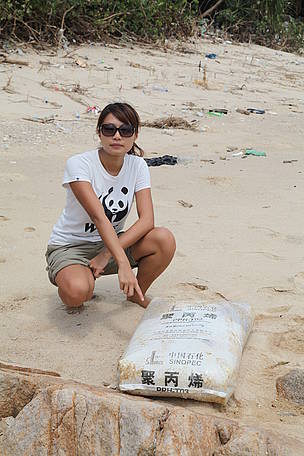
Samantha Lee Plastic pellets