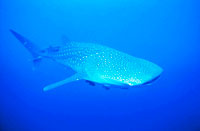
WWF Marine Ambassador Ekin Cheng interacts with the world's largest fish in the Philippines

The story will be featured in a half-hour programme named "WWF Special: Ekin and Whale Sharks" on TVB Jade Channel on 21 August 2007 at 11 pm.
"I found the trip a very inspiring experience in which I saw how WWF, along with the local fishermen and authorities, has helped conserve the world's biggest fish and establish ecotourism activities. WWF has successfully brought the conservation benefits to both wildlife and humans by working closely with the local fishermen and government. It is a good example showing how humans can exist in harmony with nature," said Ekin Cheng.
"In Hong Kong, we have designated 4 marine parks, but fishing even with nets is still allowed in our Marine Parks. There is only 1 marine reserve, but this actual no-take zone only takes up 0.016% of Hong Kong waters. Hong Kong's supposed protective measures are having virtually no positive effect on the depleted fishery resources. We must do something urgently to address the issues," said Ekin.
WWF proposed to designate 10% of Hong Kong waters as no-take zones in our "SOS- Save Our Seas" campaign. By doing so, WWF hopes to create fishery spawning and nursery grounds in Hong Kong. The potential recovery of the fish species and population will definitely have a positive impact on the livelihood of fishermen. To learn more about WWF's SOS campaign, please visit www.wwf.org.hk
The survival of whale sharks was threatened by the growing demand for whale shark meat during the early 1990s with at least 15 villages in southern Philippines involving in the whale shark fishery and each was catching an average of 26 whale sharks per year. Increasing demand for whale shark meat and fins in Southeast Asia has posed serious threats to the species. At the international market, whale shark meat commands a price from $4.8 per kilogram to $16.7 per kilogram.
In an effort to save the species, WWF, together with the Local Government Unit and Donsol Municipal Tourism Council, implemented the Butanding Ecotourism Development Project. The project included the development of Donsol Eco-tourism Management Plan, training of selected members of the fishing villages to deliver ecotourism services. The programme is highly successful bringing in more than 7,000 registered tourists to Donsol in 2005 with Php 35 million contributed to the national economy.
"Donsol is a very small fishing village with only 40,000 people and resources are very limited. However, everybody shows a very strong determination to protect their own marine resources and marine environment. I am very impressed by their concerted efforts of protecting whale sharks and I wish the Hong Kong people, fishing communities and the government could join forces to protect our threatened marine resources," pledged Ekin.
A public donation hotline at 2523 2316 will be available for public to make donations to support WWF's marine conservation work. Donations can also be made by crossed cheques payable to "World Wide Fund For Nature Hong Kong", credit cards or PPS (WWF Hong Kong Merchant Code at 9502). For inquires regarding donations, please call 2523 2316.
"We all share the responsibilities of protecting our natural environment for our future generations. All we need is the strong determination and commitment to achieve the objectives," concluded Ekin.
About Whale sharks
Whale sharks are known to grow up to 15 to 20 meters and can weigh up to 34 tonnes. They have very distinctive color markings of pale spots and stripes against a dark background. The head is broad and flattened with a large almost terminal mouth and its teeth are minute. Unlike other species of sharks, whale sharks can neither bite nor chew. Its thousand of teeth are so tiny that it can only eat small shrimps, fish and plankton. According to the information of IUCN, the whale shark is listed as 'vulnerable to extinction'.